
















meshDETECT® is pleased to announce that it has been granted a sixth wireless blockchain patent from the United States Patent and Trademark Office for U.S. Patent 11,956,383 entitled “Systems and Methods For Blockchain Wireless Services In a Controlled Environment.” This is our twelfth patent granted overall. The claims in our latest blockchain patent are directed toward a multi-blockchain system to secure, manage, and validate forensic data in controlled environments such as prisons and jails Digital […]
meshDETECT® is pleased to announce that it has been granted a fifth wireless blockchain patent from the United States Patent and Trademark Office (USPTO) for U.S. Patent 11,689,658 entitled “Systems and Methods For Blockchain Wireless Services In a Controlled Environment.” This is our eleventh patent granted overall. The claims in our latest blockchain patent are directed toward: Leveraging the blockchain to ensure and prove that a privileged voice or video call from an inmate in […]
This latest patent protects the intellectual property necessary to enhance inmate wallet functionality, improve transaction security, and expand services rental and payment functionality via smart contracts, dAPPs and custom tokens.
China’s eastern Jiangsu province has applied blockchain technology in prison management for parole, commutation and prisoner assessments, a local newspaper reported. The official Xinhua Daily in Jiangsu reported last week that the blockchain-supported smart prison system used in 21 prisons in the province has been endorsed by the Ministry of Justice, which recommended promoting the idea to the more than 600 prisons nationwide. According to the report, the platform adopted by the provincial prison authority […]
Securus is requesting approval from the FCC to transfer control of Preferred Communications of Texas, LLC from Embarq to Securus. Preferred’s sole asset is the contract to provide services to the Texas Department of Criminal Justice (TDCJ) for which Securus is the subcontractor. Embarq formed Preferred last year to hold the TDCJ Contract when it sold the rest of its incarcerated calling services (ICS) to Inmate Calling Solutions, LLC (d/b/a ICSolutions). With the transfer of […]
meshDETECT® is pleased to announce that it has recently received a notice of allowance for our third wireless blockchain patent from the United States Patent and Trademark Office (USPTO) for U.S. Patent Application Number 16/953,676 entitled “Systems and Methods For Blockchain Wireless Services In a Controlled Environment.” A notice of allowance from the United States Patent and Trademark Office is a written notification that a patent application has cleared internal review and is pending issuance. […]
Consolidation within the prison payphone communications industry, also known as inmate communications services (ICS), continues with Global Tel*Link (GTL) asking the FCC for approval to buy (some? all?) of the assets of Legacy/Edovo. GTL is the largest provider of ICS in the US. Legacy Inmate Communications is a wholly owned subsidiary of Jail Education Solutions, Inc. d/b/a Edovo (“Edovo”). From the FCC filling, “On July 2, 2020, GTL, Legacy, and Edovo entered into a Master […]
The claims in this latest patent are directed toward managing commissary transactions using blockchain and smart contracts, for token management supported by a blockchain and for the enforcement of regulations in a controlled environment.
meshDETECT® is pleased to announce that it has recently received a notice of allowance from the United States Patent and Trademark Office (USPTO) for U.S. Patent Application Number US16/386,248 entitled “System and method for controlling, monitoring and recording of wireless telecommunications services in penal institutions.” This is our sixth patent overall and the fifth in this family of patents. A notice of allowance from the United States Patent and Trademark Office is a written notification […]
meshDETECT® is pleased to announce that it has recently received a notice of allowance from the United States Patent and Trademark Office (USPTO) for U.S. Patent Application Number 16/517620 entitled “Systems and Methods For Blockchain Wireless Services In a Controlled Environment.” A notice of allowance from the United States Patent and Trademark Office is a written notification that a patent application has cleared internal review and is pending issuance. This fifth patent expands our Secure […]
meshDETECT® is pleased to announce that it has recently received a notice of allowance from the United States Patent and Trademark Office (USPTO) for U.S. Patent Application Number 15/700,144 entitled “System and method for controlling, monitoring and recording of wireless telecommunications services in penal institutions.” A notice of allowance from the United States Patent and Trademark Office is a written notification that a patent application has cleared internal review and is pending issuance. This fourth […]
The UK Justice Secretary recently announced that more prisoners will get in-cell phones to help maintain the family ties which can cut re-offending by 40%. The Justice Secretary unveiled plans for a further £10 million roll-out of in-cell landline telephones to help prisoners preserve relationships with their own loved ones and reduce tension on prison wings. In justifying the investment, the announcement highlighted the three main benefits of enhanced communication: Family ties are a vital […]
Prisons want jamming technology to stop criminal activity, but critics warn there would be dire consequences if jamming was allowed to propagate. In June the Department of Justice released a report that declared a solution to prevent criminal activity from happening within prisons: it successfully tested a jammer that would block mobile signals from smuggled cell phones inside a Maryland prison. Throughout the corrections world the news spread fast. For South Carolina Corrections director Brian […]
In July, 2018 the UK’s Prison and Probation Service issued a report that detailed the findings from research that looked at the demand and use of illicit phones in prisons. The report explores the use of smuggled mobile phones in prison in considerable detail, contrasting the views of prison staff and prisoners themselves on why and how prisoners increasingly use mobiles inside prisons. The aim of the research was to understand what drives the demand […]
Aisto® is a new, patented, blockchain enabled service from meshIP®. More than just the underlying technology for Bitcoin or other crypto tokens used to facilitate transactions, the blockchain has many practical uses, including within the corrections industry. A blockchain definition: A blockchain is a database that is distributed among multiple computing devices. A blockchain is formed from blocks, with each block having information related to a transaction and linking the block to a prior block […]
According to the DOJ, the National Telecommunications and Information Administration (NTIA) has posted a report detailing its findings from the Jan. 17, 2018 test of micro-jamming technology conducted at the Federal Correctional Institution at Cumberland, Maryland. Data from the test show that the micro-jammer’s signal disrupted commercial wireless signals inside the prison cell, which meant that if cellphones were operating inside the cell, they would have been rendered inoperable. At 20 ft. and 100 ft. […]
T-Mobile recently submitted to the FCC a study comparing Managed Access Systems (“MAS”) and precision jamming systems (micro-jamming) as potential solutions to prevent contraband phone use in correctional facilities. This study was submitted to Docket 13-111, Promoting Technological Solutions to Combat Contraband Wireless Device Use in Correctional Facilities. The study provides an overview of MAS and micro-jamming solutions examining both technical and cost considerations. The paper finds that the cost to deploy and operate the […]
Recently meshIP, LLC submitted comments to the FCC’s Docket No. 13-111, Promoting Technological Solutions to Combat Contraband Wireless Device Use in Correctional Facilities. We are re-posting those comments here: Introduction meshIP, LLC (“meshIP” or “Company”) respectfully submits these comments in response to the Federal Communications Commission’s (“FCC” or “Commission”) Report & Order and Further Notice of Proposed Rulemaking (“FNPRM”) in the above- captioned proceeding. meshIP is the provider of meshDETECT© Secure Prison Cell Phone Solutions™. meshDETECT© […]
Here is the latest summary of recent news articles regarding contraband cell phones in prisons around the world. I call these periodic round up of news items, “Wireless Prison Payphone™ Briefs” because this is essentially what smuggled mobile phones in jails have become – a substitute for the current wall mounted prison payphones. Two years ago, we explored some of the news regarding wireless prison tablet devices; which highlighted how prison payphones were being replaced […]
meshDETECT® is pleased to announce that it has recently received a notice of allowance from the United States Patent and Trademark Office (USPTO) for U.S. Patent Application Number 14/945,145 entitled “System and method for controlling, monitoring and recording of wireless telecommunications services in penal institutions.” A notice of allowance from the United States Patent and Trademark Office is a written notification that a patent application has cleared internal review and is pending issuance. This patent […]

After last year’s announcement by the CDCR that they would halt the deployment of the managed access systems touted to stop the supply of contraband cell phones into California’s state prisons, the Department of Corrections and Rehabilitation has now announced it is installing 272 more metal detectors, 68 X-ray machines to scan packages, 103 low-dose X-ray scanners, 170 hidden surveillance cameras, 34 devices to decrypt and analyze cellphones, and 272 scanners that detect magnetic signals […]
The FCC has frequently advocated for competition in the provision and availability of inmate communications services (ICS) in prisons and jails. In its Second Report And Order And Third Further Notice Of Proposed Rulemaking (NPRM) adopted on 10/22/15, it wrote, “While we adopt regulations in this Order to correct failures in the ICS market, the Commission generally prefers to rely on competition over regulation. We seek additional comment on whether there are ways to promote […]
An interesting article in light of the recent letter submitted to the FCC by ten Republican governors who want the Federal Communications Commission to give states more autonomy to apply technology that can stop prison inmates from using smuggled cellphones. Gov. Nikki Haley and her counterparts encouraged FCC Chairman Thomas Wheeler in a letter Monday to give them “flexibility and authority” to render such communication impossible. While the letter doesn’t explicitly say so, what the […]

On March 7, 2016, the United States Court of Appeals for the District of Columbia Circuit (D.C. Circuit) stayed two provisions of the FCC’s ICS rules: 47 CFR § 64.6010 (setting caps on ICS calling rates that vary based on the size and type of facility being served) and 47 CFR § 64.6020(b)(2) (setting caps for single-call services). The D.C. Circuit’s March 7 Order denied motions for stay of the FCC’s ICS rules “in all […]

This news tracks with reports elsewhere that this technology to block cell phone usage in prisons is problematic. An effective contraband cell phone strategy should focus on reducing demand, in addition to restricting supply. Corrections officials have shared with us the fact that at least 40% of the calls intercepted by these systems are to phone numbers on inmates’ approved calling lists. We suspect that an even higher percentage are to other family and loved […]
meshDETECT® is pleased to announce that it has recently received a notice of allowance from the United States Patent and Trademark Office (USPTO) for U.S. Patent Application Number 13/931,850, which is a continuation of our first patent entitled “System and method for controlling, monitoring and recording of wireless telecommunications services in penal institutions.” A notice of allowance from the United States Patent and Trademark Office is a written notification that a patent application has cleared […]

UPDATE (10/22/15): The order passed at the FCC by a vote of 3 to 2. Securus and Global Tel*Link immediately issued statements indicating they would seek a stay of the order and appeal to the United States Court of Appeals, D.C. Circuit, to get the entire decision overturned. Original Post: After a year of seeking comments on its Further Notice of Proposed Ruling Making focused on inmate phone call rates and fees, the FCC has released […]
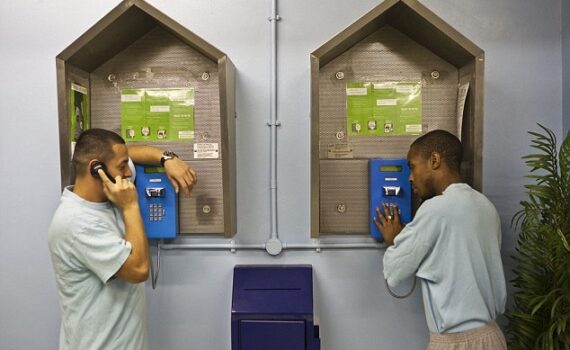
Here is the latest summary of recent news articles regarding contraband cell phones in prisons around the world. I call these periodic round up of news items, “Wireless Prison Payphone™ Briefs” because this is essentially what smuggled mobile phones in jails have become – a substitute for the current wall mounted prison payphones. In this edition, we explore some of the recent news regarding prison tablet devices and how they highlight what we have been […]

A cautionary tale for prisons contemplating shelling out millions of dollars for managed access systems to jam contraband cell phones. A prison in New Zealand has spent over $11M (US) in installation and upgrades on a cellular signal jamming system that has not prevented the ongoing use of wireless devices. Taxpayers have forked out $17 million on cellphone jamming technology for prisons – but inmates continue to be caught with increasing numbers of contraband mobile […]

The National Sheriffs’ Association (NSA), in a recent FCC filing for Docket No. 12-375 (Inmate Calling Services), made the case that jails should be compensated for the costs they incur to allow inmate calling service (ICS). The FCC, in its Second Further Notice of Proposed Rulemaking (SFNPRM), proposed the elimination of the payment of site commissions as a category to correctional facilities, including jails. On January 12, 2015, NSA’s submitted a cost survey to the […]

As we have commented before, we believe that contraband cell phones are a problem of both supply and demand. Due to the demand for cell phones in prison, there is an active and highly lucrative pipeline of supply. Most prison administrations have focused on restricting the supply of contraband cell phones through detection, jamming and search. However, like the problem of drug smuggling, without addressing the demand for contraband, the problem will never be solved. […]

The first round of comments on the FCC’s Second Notice of Proposed Rulemaking regarding the reduction of the cost of all inmate calls are in. Here is one of the more interesting insights we have gleaned from those submissions: The Prison Policy Initiative’s submission on advanced inmate communications services in prison discusses the very real need that these new services (such as the meshDETECT Secure Prison Cell Phone Solution) address: These Services Address a Real […]

The inmate communication services industry is being fundamentally reshaped by the FCC. Potentially more significant than its predecessor initiative, which significantly reduced prison payphone long-distance rates, the recently issued Further Notice of Proposed Rulemaking seeks comment on key drivers of revenue and profit for these prison payphone providers and the prisons themselves. With the two largest providers of payphone services owned by private equity firms, not usually known for embracing a shrinking profit model, it […]

Innovation, especially technology innovation, requires a willingness to challenge accepted approaches to problems as well as entrenched industry “truths”. This nontraditional thinking is best captured by a quote from hockey great Wayne Gretzky, “I skate to where the puck is going to be, not where it has been.” Back in June of 2011, we issued a press release announcing the introduction of the meshDETECT Secure Prison Cell Phone Solution. In the press release we said, […]

Today I participated in the FCC’s Workshop on Inmate Calling Services Reform on the New Technologies panel to consider new and emerging forms of communications in correctional settings beyond the traditional wireline telephone call. Below is the text of my opening statement: As this workshop is focused on inmate calling services and this panel is specifically targeted to new technologies, I would like to focus my opening comments on a new solution to the problem […]

A Texas Tribune investigation has found that few inmates or correctional officers face legal consequences for smuggling cellphones even as prison officials have intensified efforts to keep the devices out of prisons. Just 5 percent of cellphone smuggling cases investigated by the Criminal Justice Department’s Office of Inspector General from 2009 to 2013 resulted in a criminal sentence, according to documents obtained from the office through a public information request. Some notable excerpts from the […]
The Justice Department will require Federal Bureau of Prison halfway houses to boost services for inmates prior to release. The new rules also instruct federal work release facilities to provide cell phone access in order to help inmates seek employment opportunities. Once fully implemented, these services will be available to every single one of the approximately 30,000 inmates who are released through halfway houses each year. Several other modifications are being made to the standard […]

Here is the latest summary of recent news articles regarding contraband cell phones in prisons around the world. I call these periodic round up of news items, “Wireless Prison Payphone™ Briefs” because this is essentially what smuggled mobile phones in jails have become – a substitute for the current wall mounted prison payphones. Convicted Killer Among Group of Prisoners Given Permission to Buy Mobile Phone: A convicted killer is among a group of prisoners at […]

The United Kingdom’s Ministry of Justice has determined that managed access jamming of contraband cell phones is too expensive and has commissioned “research to explore the use and demand for illicit mobile phones amongst the prison population” in order to facilitate the “development of a new mobile phone strategy to: (i) manage prisoner communications, (ii) reduce and control criminal activities and (iii) reduce expenditure on equipment and the need for time-consuming searches.” The aim […]

As states continue to deal with unprecedented fiscal strain, most are taking steps to reduce their inmate populations and costs while protecting public safety and holding offenders accountable. In the current fiscal climate, states are increasingly forced to do more with less and make difficult decisions about competing priorities. The National Conference of State Legislatures recently reported that corrections and public safety spending were above budgeted levels in seven states, including Alaska, where corrections spending […]

As we have written before, managed access cell phone jamming systems being tested in prisons around the world have been deployed with mixed results. In addition to requiring ongoing management and investment post deployment, they have a spotty record and not all vendor’s equipment works as advertised. Recently, the Cayman Islands issued a report on their managed access trial. According to the report, which is discussed in the article below, “The prisons service installed a […]

A disruptive innovation is an innovation that helps create a new market and value network, and eventually goes on to disrupt an existing market and value network (over a few years or decades), displacing an earlier technology. The term is used to describe innovations that improve a product or service in ways that the market does not expect, typically first by designing for a different set of consumers in a new market and later by […]